If you’re aiming to immigrate to Canada or apply for Permanent Residency (PR), demonstrating strong language skills is essential. Along with English tests, proving French proficiency through exams like the TEF (Test d’Évaluation de Français) or TCF (Test de connaissance du français) can significantly boost your profile. Both tests are approved by Immigration, Refugees, and Citizenship Canada (IRCC).
In this guide, we focus on the TEF Canada, specifically the Speaking (Expression Orale) section, and how you can effectively prepare for it.
Quick Overview of TEF
The TEF Canada is administered by the Chambre de Commerce et d’Industrie de Paris (CCIP) and is recognized globally as a reliable benchmark of French proficiency. It has been officially accepted by IRCC since 2002 for federal immigration programs such as Express Entry, as well as for Quebec immigration (TEF Québec).
Beyond immigration, TEF results are also valuable for work, study, and residency applications in various French-speaking regions.
TEF Canada Speaking (Expression Orale) Test
The Speaking section assesses your ability to communicate effectively in French in real-life contexts. It evaluates how well you express ideas, interact naturally, handle conversations, and respond appropriately to different situations.
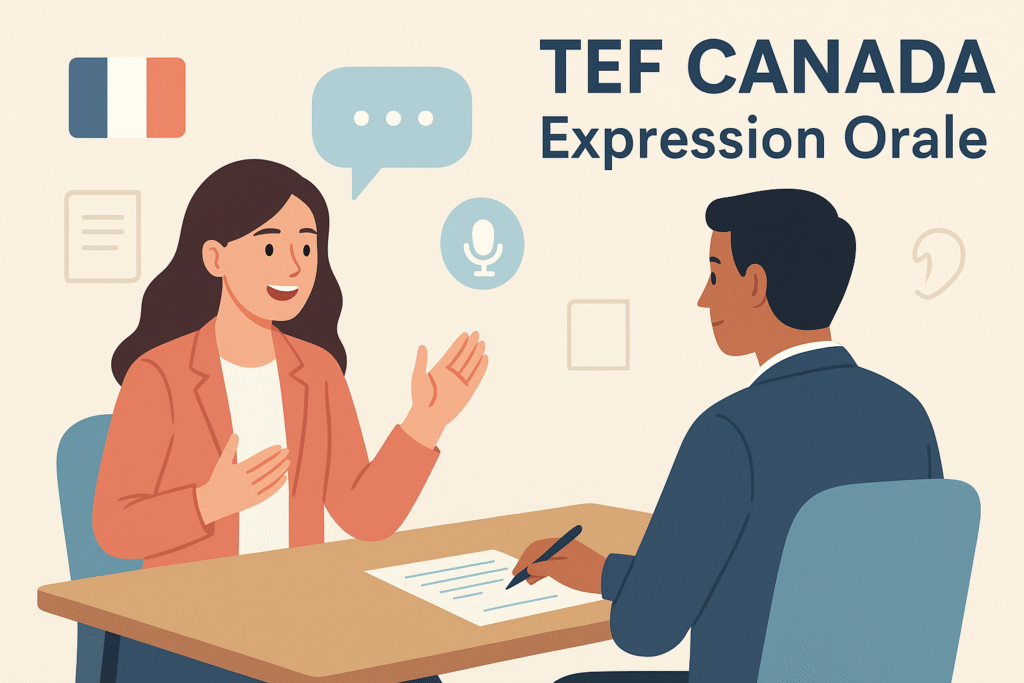
Exam Format
Duration: 15 Minutes
The TEF (Test d’évaluation de français) Speaking exam consists of a 15-minute in-person conversation with an examiner, divided into two role-play tasks: a 5-minute information-gathering activity (Section A) and a 10-minute argumentative or persuasive exchange (Section B). These tasks are based on practical, everyday situations—such as advertisements or job postings—and are designed to evaluate your ability to communicate effectively and defend your viewpoints in French for immigration requirements.
Section A: Information Exchange
Task: You’ll see an ad (for a service, apartment, job, etc.) and call the examiner (playing the role of the provider) to ask questions to learn more details.
Time: Approximate 5 Minutes
Your Role: Be curious and ask at least 10-12 relevant questions (e.g., price, location, hours, comfort).
A guided conversation where the examiner and candidate interact about a practical situation.
You may be asked to:
- Request/Provide information
- Express needs or preferences
- Ask questions
- Make suggestions
- Clarify or confirm details
This task assesses your ability to communicate naturally, initiate dialogue, and manage an everyday conversation.
Section B: Argumentation / Opinion
Task: You’ll see another ad and must convince your friend (the examiner) to try it, presenting your views and giving examples.
Time: Approximate 10 Minutes
Your Role: Be curious and ask at least 10-12 relevant questions (e.g., price, location, hours, comfort).
A more advanced, discussion-based task where you must:
- Express your opinion on a given topic
- Justify your point of view
- Provide reasons and examples
- Present pros and cons
- Respond to the examiner’s follow-up questions
- Defend or refine your argument
This task evaluates your ability to develop logical reasoning, structure your thoughts, and speak confidently in a formal context.
Scoring System
Unlike Listening or Reading, the Speaking test is not multiple-choice. Trained examiners evaluate your performance based on:
- Clarity and fluency
- Pronunciation and accent
- Vocabulary range
- Grammar accuracy
- Quality of interaction with the examiner
- Ability to justify, explain, argue, and react
Your results are matched to CLB levels (4–10+) for immigration scoring.
Common Speaking Task Themes
You may encounter scenarios such as:
Section A: (Practical interaction)
- Renting an apartment
- Asking for service or information
- Planning an event or activity
- Resolving a problem or misunderstanding
- Booking a service (hotel, transport, etc.)
Section B: (Argumentative discussion)
- Technology and society
- Environmental issues
- Work-life balance
- Education and learning
- Health, lifestyle, or culture
Topics are accessible and designed to allow candidates of all levels to express themselves.
Preparation Tips for TEF Speaking
Here’s how to prepare effectively for the Speaking section:
- Practice speaking French daily, even if informally.
- Learn useful phrases to structure your speech (e.g., à mon avis, selon moi, par contre, d’une part…).
- Focus on clarity over perfection—communicating your message is key.
- Use examples and explanations to strengthen your arguments.
- Avoid very short answers—develop your ideas.
- Record yourself to identify pronunciation or fluency issues.
- Practice with a partner or tutor to simulate real test conditions.