French4Canada


French4Canada Academy offers live online French classes, structured A1–B2 learning programs, and expert-led TEF & TCF Canada exam preparation.
If you’re aiming to immigrate to Canada or apply for Permanent Residency (PR), demonstrating strong language skills is essential. Along with English tests, proving French proficiency through exams like the TEF (Test d’Évaluation de Français) or TCF (Test de connaissance du français) can significantly boost your profile. Both tests are approved by Immigration, Refugees, and Citizenship Canada (IRCC).
In this guide, we focus on the TEF Canada, specifically the Speaking (Expression Orale) section, and how you can effectively prepare for it.
The TEF Canada is administered by the Chambre de Commerce et d’Industrie de Paris (CCIP) and is recognized globally as a reliable benchmark of French proficiency. It has been officially accepted by IRCC since 2002 for federal immigration programs such as Express Entry, as well as for Quebec immigration (TEF Québec).
Beyond immigration, TEF results are also valuable for work, study, and residency applications in various French-speaking regions.
The Speaking section assesses your ability to communicate effectively in French in real-life contexts. It evaluates how well you express ideas, interact naturally, handle conversations, and respond appropriately to different situations.
Duration: 15 Minutes
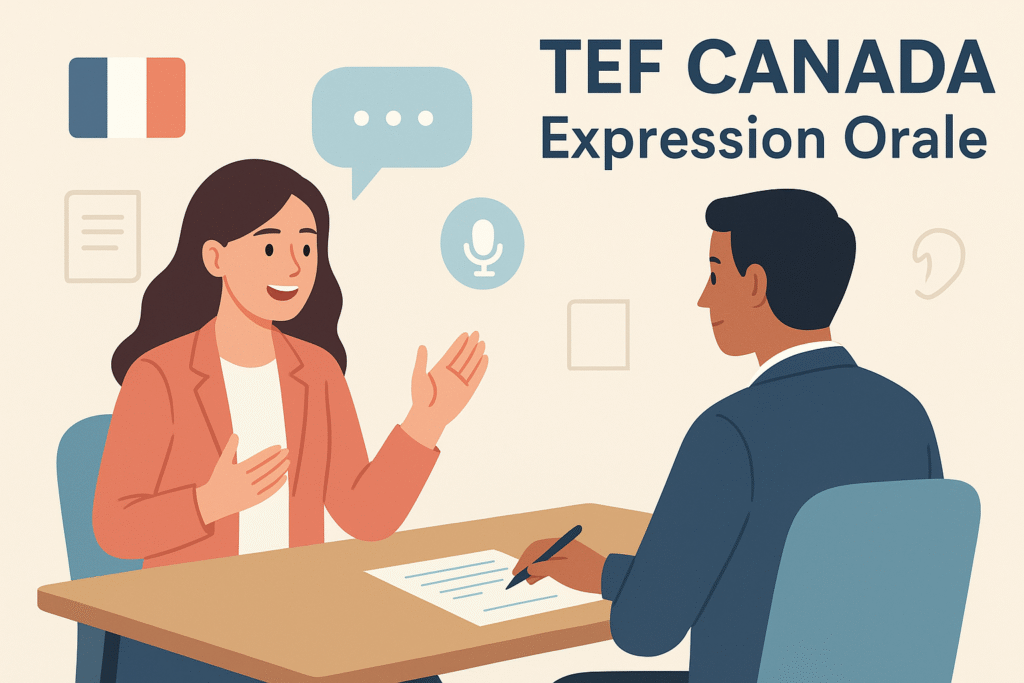
The TEF (Test d’évaluation de français) Speaking exam consists of a 15-minute in-person conversation with an examiner, divided into two role-play tasks: a 5-minute information-gathering activity (Section A) and a 10-minute argumentative or persuasive exchange (Section B). These tasks are based on practical, everyday situations—such as advertisements or job postings—and are designed to evaluate your ability to communicate effectively and defend your viewpoints in French for immigration requirements.
Section A: Information Exchange
Task: You’ll see an ad (for a service, apartment, job, etc.) and call the examiner (playing the role of the provider) to ask questions to learn more details.
Time: Approximate 5 Minutes
Your Role: Be curious and ask at least 10-12 relevant questions (e.g., price, location, hours, comfort).
A guided conversation where the examiner and candidate interact about a practical situation.
You may be asked to:
This task assesses your ability to communicate naturally, initiate dialogue, and manage an everyday conversation.
Section B: Argumentation / Opinion
Task: You’ll see another ad and must convince your friend (the examiner) to try it, presenting your views and giving examples.
Time: Approximate 10 Minutes
Your Role: Be curious and ask at least 10-12 relevant questions (e.g., price, location, hours, comfort).
A more advanced, discussion-based task where you must:
This task evaluates your ability to develop logical reasoning, structure your thoughts, and speak confidently in a formal context.
Unlike Listening or Reading, the Speaking test is not multiple-choice. Trained examiners evaluate your performance based on:
Your results are matched to CLB levels (4–10+) for immigration scoring.
You may encounter scenarios such as:
Section A: (Practical interaction)
Section B: (Argumentative discussion)
Topics are accessible and designed to allow candidates of all levels to express themselves.
Here’s how to prepare effectively for the Speaking section: